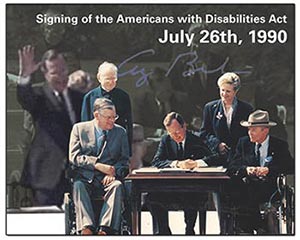
THE AMERICANS WITH DISABILITIES ACT
On July 26, 1990, President George W. Bush signed into law The Americans with Disabilities Act (ADA). This law has since been viewed as one of the most important civil rights laws since the Civil Rights Act of 1964. The ADA "prohibits discrimination against people with disabilities in employment; state and local government activities; public accommodations; public transportation; telecommunications; and public services" (ADA, 1990). Title II of the ADA protects Americans with disabilities from discrimination in publicly funded services which include public libraries.
According to the ADA's definition of mental illness, a person must meet one of these three criteria to be mentally disabled: "(1) a physical or mental impairment that substantially limits one or more major life activities of an individual; (2) a record of such an impairment; or (3) being regarded as having such an impairment."
The ADA has defined mental impairment as "any mental or psychological disorder, such as mental retardation, organic brain syndrome, emotional or mental illness, and specific learning disabilities" (ADA, 1990).
This far-reaching law protects people with mental illness from discrimination and guarantees that they be afforded fair and equitable access to library services.